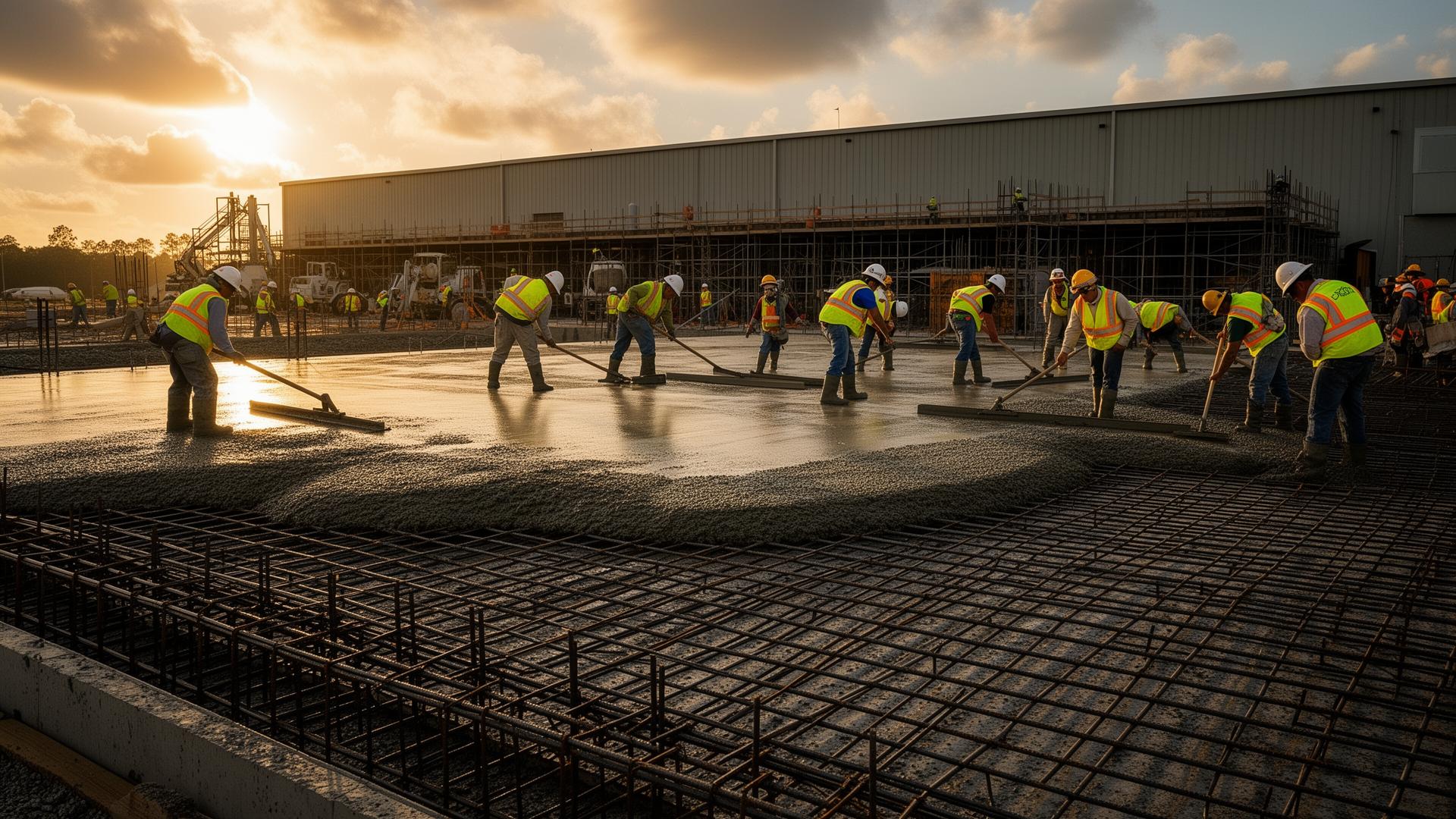
On a Florida commercial jobsite, weather planning starts before the first truck arrives. Air temperature, concrete temperature, humidity, wind, and direct sun interact differently throughout the day. A cloudy, humid morning can become a sunny, breezy afternoon; a ready subgrade can be saturated by an overnight storm. The goal is not simply to avoid rain. It is to give placement, finishing, and curing a workable window while keeping the supporting ground, delivery route, and protection plan ready.
Heat and humidity do different things
Higher concrete temperatures generally accelerate hydration and shorten the time available for transporting, placing, and finishing the mix. Hot forms, reinforcing, and subgrade can contribute to the problem. Slump loss may become more noticeable, and a mix that worked well in cooler conditions may require a different handling plan. Any adjustment should be coordinated with the ready-mix producer and follow the project specifications, rather than rely on improvised water addition at the site.
Humidity is not a reliable guide to setting time. High relative humidity can reduce surface evaporation, but it does not cancel the effects of warm concrete. Lower humidity, wind, sunlight, and a warm surface can increase evaporation enough for the top to dry before the concrete beneath is ready to finish. That condition can encourage plastic shrinkage cracking or mislead finishers. A surface that looks dry is not necessarily ready for the next finishing pass.
Build the pour window around the whole operation
Early starts can reduce exposure to the strongest sun and leave more time before afternoon storms, but they are not a universal solution. Supplier availability, local working-hour restrictions, inspection readiness, lighting, and crew access all need to align. The planned window must cover delivery, placement, finishing, and initial protection—not just the start of discharge. A large floor with delayed trucks can carry unfinished work into weather that was avoidable when the first load arrived.
Before release, agree on placement size, truck spacing, pumping or direct-discharge access, and backup arrangements. Ask the producer whether an approved hot-weather mix approach is appropriate, including permitted admixtures or temperature-control measures. Do not assume a retarder replaces good logistics or curing. For industrial concrete floors, the sequence also needs to respect specified joints, floor tolerances, and finish requirements. Any change in pour boundaries should be reviewed against the approved details.
Protect the surface without rushing the finish
Check exposed base and contact surfaces before placement. Where the specifications call for dampening, avoid leaving standing water; vapor retarders and other assemblies require their own handling. During placement, approved windbreaks, shading, fogging, or evaporation-control products may help manage surface moisture loss. These measures have different purposes: an evaporation reducer is not a substitute for curing, and fogging should not leave water that is worked into the slab surface.
Finishing must follow the concrete’s condition, not the clock alone. Working bleed water into the surface or adding water to make finishing easier can weaken the surface and contribute to defects. Weather can change the relationship between surface appearance and the concrete below, so the crew needs to monitor both. If rain arrives, protect the work when practical and stop operations that would incorporate rainwater. Do not scatter dry cement over a wet surface as a repair shortcut.
Curing begins when finishing allows it
Curing retains moisture and supports the conditions needed for strength development and durability. Humid Florida air does not make curing optional: exposed concrete can still lose moisture under sun and wind. Start the specified curing method as soon as the finished surface can accept it without damage. Methods may include curing compounds, maintained wet coverings, or suitable sheet materials. Follow the project requirements for application, coverage, duration, and protection rather than choosing a method solely for convenience.
Coordinate curing with what happens afterward. Compounds may need to be compatible with coatings, adhesives, or later flooring installation. Wet coverings require maintenance, and sheets must be secured and kept in proper contact. Assign responsibility for keeping protection intact when other trades return. Early traffic, stored materials, or removed coverings can interrupt curing even after the concrete crew leaves. For commercial concrete, that handoff belongs in the schedule alongside placement and inspections.
Plan for storms and the ground they leave behind
Florida’s summer rainy season often brings afternoon thunderstorms, although storms can arrive outside that pattern. Use current forecasts and site conditions rather than assume a morning pour is safe. Establish a go/no-go decision, lightning-safety procedures, shelter access, and a plan for exposed concrete before dispatch. If interruption becomes necessary, construction-joint location and treatment must follow the design and approved procedures; an unplanned stopping point should not become an improvised structural detail.
Rain also affects work that has not yet been poured. Inspect excavations, standing water, eroded base, and soft or disturbed subgrade after storms. Dewatering, drainage corrections, and renewed compaction or testing may be needed before the area is released. Keep trucks and pumps off surfaces that cannot support them. Review these responsibilities with the GC and grading contractor, along with our concrete services, so weather recovery is assigned rather than left between trades.
A useful pre-pour conversation confirms the forecast, approved mix, site readiness, delivery sequence, finishing plan, curing materials, and who can stop the operation. Share schedule constraints and flooring requirements with the concrete subcontractor early. A realistic weather contingency does not promise an unchanged date; it helps the team protect the work and restart on a sound basis when conditions improve.
Planning a Florida concrete placement?
Send us plans, specs, or a scope outline and our estimating team will review the opportunity.
Request a Bid